
Right Click Accounting Logo

Your Meta Ads Are About to Cost More from July 2026…Is Your Business Ready?

The Meta Ads Update You Can’t Ignore

If you’re running paid ads on Facebook, Instagram, Threads or WhatsApp, there’s a change coming in July 2026 that’s worth getting your head around now; before it shows up unexpectedly on your invoice.
It’s not going to derail a well-planned campaign, but it will affect your; costs, your reporting and potentially a conversation or two with your finance and marketing team. Understanding it ahead of time means you can plan for it calmly rather than react to it in a hurry.

What's Actually Changing?

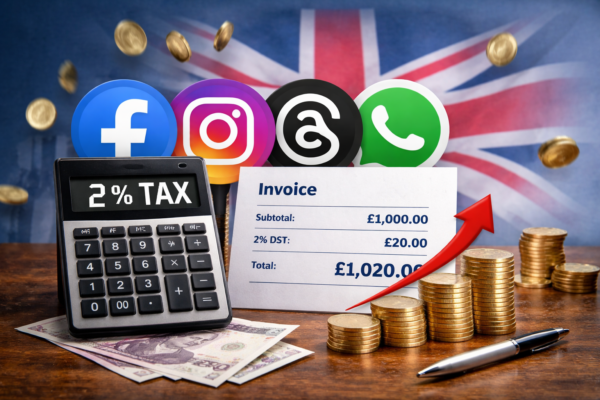
From 1 July 2026, Meta will apply a 2% Digital Services Tax (DST) charge on all UK-targeted ad spend across Facebook, Instagram, Threads and WhatsApp.
 
The Digital Services Tax is a UK government levy applied to large digital platforms operating in the UK. Meta will be passing this cost directly on to advertisers, which is why it’s worth understanding how it’s applied.
 
The charge is added on top of your budget, not deducted from it. So if you’re spending £1,000 on ads, your invoice from Meta will be £1,020. VAT then applies to that total figure.
 
It’s a relatively small percentage, but across significant ad spend it adds up fast and if it isn’t factored into budgets from the start, it can quietly erode your margins over time.

The Part That Catches Most People Out

Here’s where it gets a little frustrating.

The 2% charge will not appear anywhere in your Meta Ads Manager dashboard. Your in-platform metrics (including ROAS, CPA and overall spend) will continue to reflect only your campaign budget, not the true total cost.
 
That means there will be a gap between what your dashboard tells you and what your invoice says. For business owners reviewing performance, or finance teams reconciling costs, that discrepancy needs to be accounted for.
 
If you’re used to pulling numbers directly from Ads Manager to report on ad performance or justify spend, your process will need a small but important adjustment from July onwards to factor this in.

What If You're Running Ads in Multiple Countries?

As a growing business, this is worth knowing if you’re currently or planning to advertise beyond the UK.
 
The DST charge is based on where your ad is seen, not where you’re based as an advertiser. Different countries carry different DST rates (for example, France applies a 3% rate). So if your campaigns run across both the UK and France, you’ll see different charges applied to impressions in each country.
 
Not every country has a DST in place, but it’s worth checking the rates applicable to any markets you’re actively targeting before running international campaigns.

Alexis - Contact Us

Three Things To Do Before July 2026

You’ll be pleased to hear that none of this requires a dramatic overhaul, but a little preparation now will save a headache later down the line. Here are the three things we recommend acting on early to ensure a smooth transition in July.


Update Your Budgets:

Build the 2% DST charge into your ad budgets from the start rather than treating it as an afterthought.

If you’re working to a fixed monthly spend, factor in the additional cost so your true investment is accurately reflected from day one.

Adjust How You Report on Performance: 

Since the charge won’t appear in Ads Manager, your in-platform metrics won’t tell the whole story.

When reviewing ROAS, CPA or overall ad spend, make sure you’re working from invoice figures rather than dashboard figures to get an accurate picture of performance.

Brief Your Finance Team:

This is probably the most important one. From July, a new line item will appear on Meta invoices that wasn’t there before.

If your finance team isn’t expecting it, it will raise questions. Get ahead of that conversation now, a quick email is all it takes.
Frequently Asked Questions

Yes. The 2% DST charge applies to UK-targeted ad spend across Facebook, Instagram, Threads and WhatsApp. If you’re running ads on any of these platforms and targeting UK audiences, the charge will apply.

Yes. VAT is applied to the total invoice amount, which includes the DST charge. So for a £1,000 campaign (including DST Charge), your invoice will show £1,020 before VAT.

No action is required on your end within Meta. The charge will be applied automatically from 1 July 2026. What you do need to do is make sure your budgets, reporting and internal communication reflect the change.

No, the DST itself doesn’t change how your ads perform or who sees them. It only affects the total cost of your campaigns and your reporting. Your audience targeting, ad delivery, and metrics like ROAS or CPA remain the same…just make sure to factor the extra cost into budgets and performance calculations.

Final Thoughts

A 2% charge might not sound like much…and for smaller budgets, it won’t be. But for growing businesses investing meaningfully in paid social, the cumulative impact is worth taking seriously. More importantly, the fact that it sits outside your dashboard means it’s easy to miss if you’re not looking for it.
 
The businesses that navigate this most smoothly will be the ones who update their budgets, adjust their reporting and brief their teams before July arrives…not after!
 
If you’d like to talk through how this fits into your wider financial planning, or how to make sure your ad spend is working as hard as it should be, we’re always happy to have that conversation. We’re not just here to support at year-end or when something goes wrong, but through every decision, challenge and milestone along the way.